

Can You Attend a Personal Hearing Yourself or should you Consult a CA? This entirely depends upon the complexity of transactions that you have undergone in the taxing year.
Quick Answer
Under Section 515 of the Income-tax Act 2025, you are legally entitled to attend the proceeding yourself or authorize a legal practitioner or accountant to appear on your behalf. Because a personal hearing only happens after the Tax Department has explicitly threatened to increase your tax, deciding whether to go DIY (Do It Yourself) or hire a professional (CA) depends entirely on the complexity of your case.
When Salaried Professionals Can Handle the Hearing Themselves (Simple Cases)
If your tax affairs strictly involve standard Indian salary and basic deductions, you might be able to handle the video call yourself. You can safely represent yourself if:
- It is a simple clerical mismatch: For example, you claimed a ₹1.5 Lakh 80C deduction, but your employer’s Form 130 only reflected ₹1 Lakh because you made a last-minute ELSS mutual fund investment. You simply need to show the investment receipt to the officer on the camera.
- Basic HRA/Rent discrepancies: If the system flagged your House Rent Allowance, and you have a registered rent agreement, bank statements proving the transfer to your landlord, and your landlord’s PAN, you can present these facts plainly without legal jargon.
Check Out: Received an Income-Tax Notice under section 268(1) (formally called 142(1))? A First-Response Guide for Salaried ProfessionalsSigns Your Case is Complex (When CA Help is Strongly Recommended)
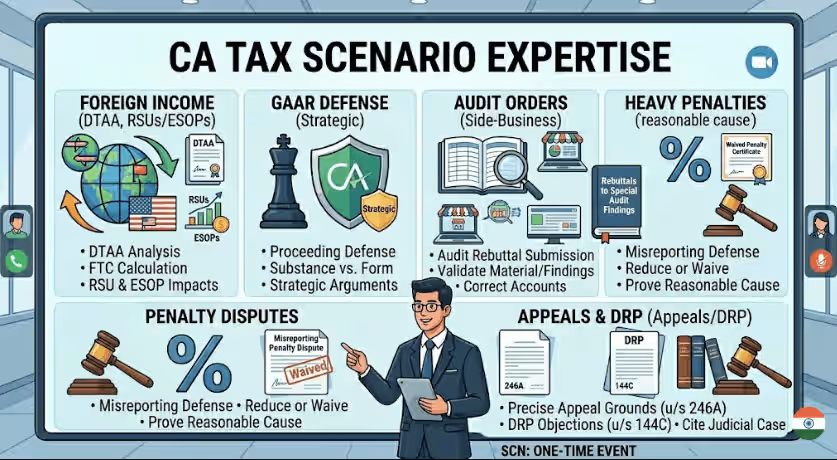
A personal hearing is your final opportunity to stop an adverse tax bill before it becomes a formal demand. It is advised that you should absolutely hire a CA if your Show Cause Notice involves:
- Foreign Income or RSUs: If you work for an MNC and the tax department is trying to tax your unvested Restricted Stock Units or rejecting your Double Taxation Avoidance Agreement (DTAA) tax credits. International taxation is incredibly complex, and algorithms frequently miscalculate foreign exchange and vesting rules.
- General Anti-Avoidance Rule (GAAR): If the notice mentions Chapter XI or GAAR, the department suspects you have structured your finances specifically to dodge taxes (e.g., routing side-income through a fake entity). You will not just be speaking to a junior officer; GAAR hearings involve Principal Commissioners and elite Approving Panels.
- Massive Misreporting Penalties: If the notice proposes initiating a penalty for “misreporting of income” under Section 439, you are facing a penalty of 200% of the tax payable on the under-reported amount. You need a CA to build a strong legal defence based on “reasonable cause”.
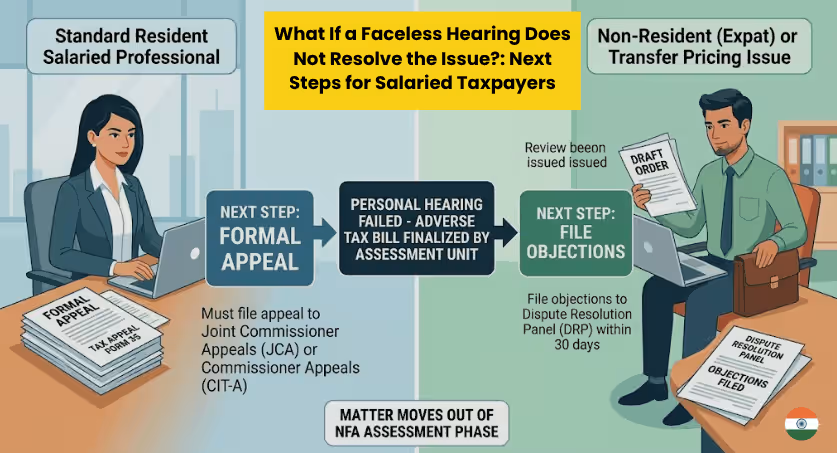
- Drafting Formal Appeals: CA can assist you with all the formal legal proceedings that require drafting precise “Grounds of Appeals” and referencing judicial case laws.
Discover More Related Post
What a CA Actually Helps With During a Virtual Hearing
A CA does not just talk for you; they provide strategic, shielded defence:
- Translating Facts into Law: While you might say, “I didn’t know that was taxable,” a CA will argue, “The assessee’s claim is supported by Section 15(1) read with Schedule VII.” Faceless technical units respond to statutory references, not emotional pleas.
- Preventing Accidental Confessions: During a live video hearing, it is easy for a nervous taxpayer to accidentally volunteer information about a different financial year or a separate side-business. A CA strictly limits the conversation to the exact boundaries of the Show Cause Notice.
- Drafting the Written Submissions: The video call is only half the battle. A CA will follow up the hearing by submitting a highly structured legal response through the NFAC portal, citing High Court and Appellate Tribunal precedents that the Assessment Unit is legally bound to consider.
Conclusion: Can You Attend a Personal Hearing Yourself or Should You Consult a CA?
Deciding whether to represent yourself or hire a professional depends entirely on the nature of the discrepancy and your comfort level with tax laws.
- Consult a CA if: Your notice involves high-stakes triggers like Section 270A (misreporting penalties), RSU valuations, or foreign tax credits. In these scenarios, the risk isn’t just the tax amount—it’s the exponential penalties and the legal precedent you set by what you say on camera.
- Go Solo if: Your case is a straightforward matter of “missing paperwork.” If you have the physical receipts for an 80C investment or a clear rent agreement that simply wasn’t uploaded correctly, the faceless assessment process is designed to be user-friendly enough for you to handle the video call.
Can You Attend a Personal Hearing Yourself or should you Consult a CA?
The law states that you may present your case “in person” (meaning you on the video call or through an “authorised representative”). An “Authorised Representative” can be a chartered accountant (CA), legal practitioner or even a regular employee or relative. However it is advised to involve CA in following complex circumstances: Foreign Income or RSUs, General Anti-Avoidance Rule (GAAR), Massive Misreporting Penalties and Drafting Formal Appeals.

Leave a Reply