
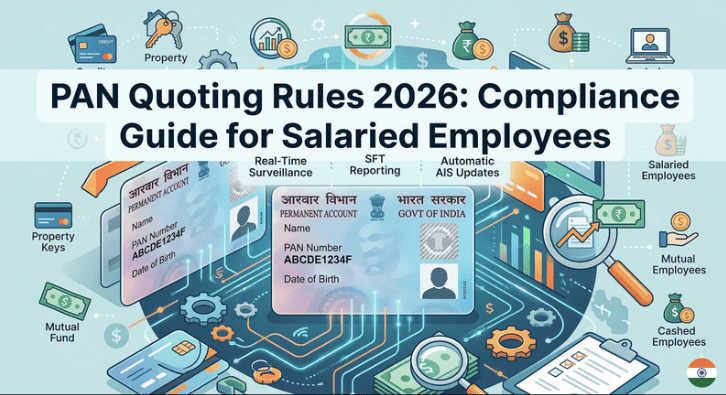
PAN Quoting Rules 2026: Know the latest limits for high-value transactions and avoid penalties with our complete guide for salaried individuals.
PAN Quoting Rules 2026: 2 Minutes Summary Table
| Nature of Transaction | Threshold (Rule 159) | The 2026 SFT Surveillance Trap (Rule 237) | Your Action Required |
| Mutual Funds / FDs | > ₹50,000 per transaction. | Aggregating > ₹10 Lakhs/year. | Quote PAN to avoid 20% TDS. |
| Cash Payments to Hotels/Banquets | > ₹1,00,000 against a bill. | N/A | Use digital payments (UPI/NEFT) for large events. |
| Buying a Car / Vehicle | > ₹5,00,000. | N/A | Provide PAN to the dealership. |
| Property Purchase/Sale | > ₹20 Lakhs. | > ₹45 Lakhs (Triggers auto-reporting). | Ensure PAN is on the sale deed. |
| Credit Card Bill Payments | Application requires PAN. | > ₹1 Lakh in Cash OR > ₹10 Lakhs total/year. | Do not pay card bills in cash. |
| Buying Goods/Services (Jewellery/Electronics) | > ₹2,00,000 per transaction. | Cash > ₹2 Lakhs (Triggers auto-reporting). | Use bank transfers for high-value items. |
The Why: The Invisible Audit (AIS+ SFT)
Recent surge in the compliance requirement for PAN quoting, PAN Linking raises a significant question: why is the government so obsessed with your PAN?
Because there has been a sharp shift in the philosophy from “voluntarily filing” to “Real-Time-Surveillance” by creating a digital tracker that populates your tax returns even before you open the website. The government has realized that chasing people they have filed their return, is inefficient. So by tracking the PAN during the Transaction, they ensure the tax is either deducted at ‘source’ or the ‘evidence’ is locked in before the year even ends.
Under Income Tax Draft Rules, 2026, the government operates on an ‘automatic surveillance system’ called Statement of financial Transactions (SFT).

How is the trap works:
The Mandate
Banks, Property Registrars, Mutual funds houses and credit card companies are legally required under Rule 237 to track your PAN against high-value- transactions.
The Reporting
If you hit a specific threshold (e.g., Rs. 10 Lakhs in mutual funds or Rs. 45 Lakhs in real estates), these institutions send a direct report to the director of income tax.
The AI Matching
Under Rule 245, the government aggregates all this third party data and uploads it directly to your Annual Information System (AIS).
Must know: Before you even log in to file your ITR. the tax department’s AI has already calculated how much you have spent and invested. If your declared salary doesn’t match your PAN linking spending, an automated tax notice is generated.The 5 Everyday Situations Where PAN is mandatory in 2026
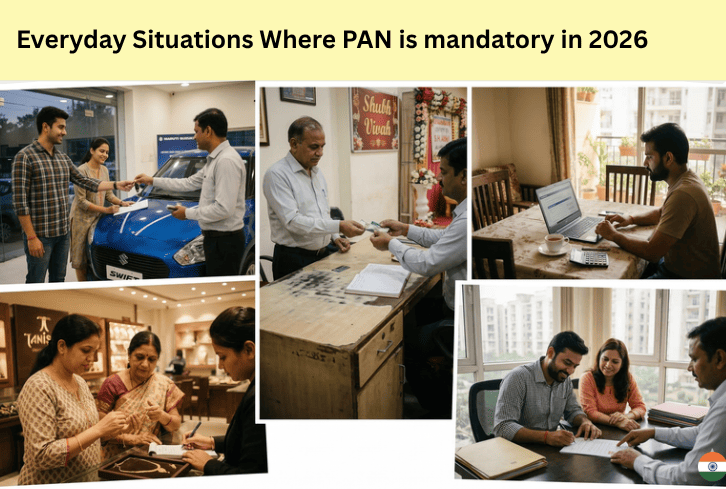
Under Rule 159, you must quote your PAN in these exact scenarios:
Property Purchase and Rent Agreement
If you are buying, selling, or gifting immovable property valued more than Rs. 20 Lakhs, the registrar officially reports the transaction to the tax department under the SFT Rules.
High-Value-Cash Deposits & Withdrawals
Depositing cash to avoid digital tracking no longer works. Banks must report if you deposit Rs. 10 Lakhs or more in your savings accounts over the financial year. For Current Accounts, the limit is Rs. 50 Lakhs.
Luxury spends or Banking Activity
If you are booking a luxury hotel, paying for a wedding banquet, or hiring an event manager, any cash payment exceeding Rs. 1 Lakh requires a PAN. Similarly, If you pay your credit card bill with more than Rs. 1 Lakh in cash or if your credit bill crosses Rs. 10 Lakhs in a year, it gets flagged.
Investing (Mutual Funds and Fixed Deposits)
You cannot invest silently. Paying more than Rs. 50,000 for mutual funds units or opening a fixed deposit exceeding Rs. 50,000 requires PAN.
General Shopping (The Rs. 2 Lakhs Rule)
Buying a massive TV, High-end Laptop or Jewellery. Any purchase or sale of goods and services exceeding Rs. 2 Lakhs per transaction legally requires shop owners to collect your PAN.
Must Know: Never pay high events bills in cash: More importantly, large cash expenditures are prime targets for lifestyle scrutiny. Always use NEFT, RTGS, or UPI for event management bills to maintain a clean digital trail.The Form 97 Trap: What happens if you don’t quote a PAN?

The Form 97 Mandate
Under Rule 159(2), if you enter into any of the high-value-transactions quoted, and you do not have a PAN, you are legally forced to submit a detailed declaration in Form No. 97.
The Transaction Reporting is still happening
Filing Form 97 does not hide you. Under Rule 160 the bank, hotel, or jeweler is legally required to digitally transmit your Form 97 details directly to the directorate of intelligence and criminal investigation.
The Notice
The automated examination tool will flag your profile. Attempting to evade PAN quoting by splitting transactions or using fake details often results in severe penalties during faceless assessments.
Pro Tip: Form 97 is Not an Invisibility Cloak Never assume that skipping your PAN and filling Form 97 keeps you off the grid.PAN “inoperative”? Your wallet will bleed.
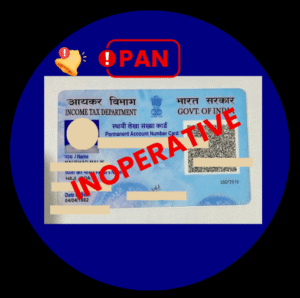
This is the biggest confusion area for salaried employees when does PAN become “inoperative”? Why does it ‘Kill Switch’ the financial Identity? What exactly does it trigger?
If you are required to link your PAN with Aadhar and you haven’t done that, then, your PAN is legally classified as ‘Inoperative’ under Rule 162. This means under the draft income tax rules 2026 framework, law treats you as if you never provided PAN at all.
Here is exactly what happens to your money if your PAN goes inoperative:
Massive TDS Deductions
Your Bank or employer will treat you as someone who hasn’t submitted a PAN. Tax will be deducted or collected significantly at higher rates (often 20%)
Refunds are blocked
The income tax department will not issue any tax refunds you are owed.
No interest paid
You will not be paid any statutory interest on your delayed refunds for the period your PAN was dead.
The 30-Day Lag
If you wake up and pay the Rs. 1000 penalty fee today, your PAN does not activate instantly. Under Rule 162(2), it takes up to 30 days for your PAN to become operative again.
Peer Tip: If your status is "Inoperative," don't just pay the ₹1,000 fine. First, check if your Name on the PAN card matches your Aadhar exactly (including initials and spaces). If they don't match, the payment will go through, but the linking will still fail.The 2026 Action Checklist of salaried Employees

Audit your PAN-Aadhar Link
Do not wait for tax season. Check the official portal today. If it is inoperative, pay Rs. 1000 fee immediately so the 30-Day activation timer begins.
Verify your Bank KYC
Ensure your PAN has your latest PAN mapped to your salary account and fixed deposits to avoid aggressive TDS Deductions.
Check Your AIS
Log into the Income Tax Portal and download your Annual Information Statement (form 168). Check if your credit card companies or mutual funds have correctly reported your data.
Track your spends
if you use your personal credit card for company expenses (reimbursements), be careful. If the total crosses Rs. 10 Lakhs, it will reflect on your AIS and you will have to explain it to the taxman.
Pro Tip: Audit Your "Form 168" (AIS) in March, Not July Do not wait until tax-filing week. Download your Form No. 168 (Annual Information Statement) under Rule 245 before the financial year ends. Common Mistakes That Trigger “Faceless” Tax Notices
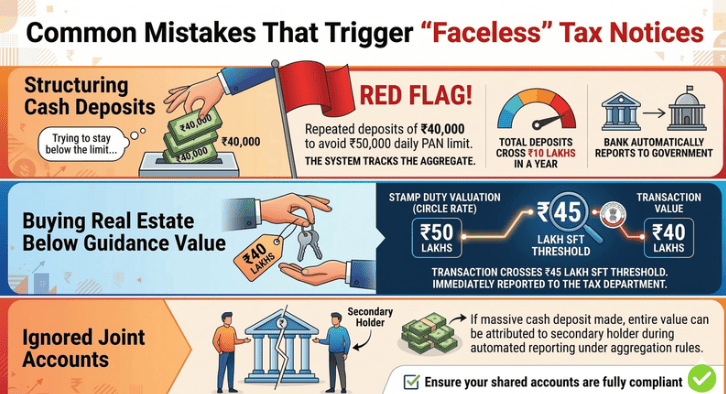
Mistake 1: “Structuring” Cash Deposits
Depositing ₹40,000 repeatedly to avoid the ₹50,000 daily PAN limit is a red flag. The system tracks the aggregate. If your total deposits cross ₹10 Lakhs in a year, the bank’s system automatically reports you to the government.
Mistake 2: Buying Real Estate Below Guidance Value
If you buy a house for ₹40 Lakhs but the stamp duty valuation (circle rate) is ₹50 Lakhs, the transaction crosses the ₹45 Lakh SFT threshold and is immediately reported to the tax department.
Mistake 3: Ignored Joint Accounts
If you are a secondary holder on a joint bank account and a massive cash deposit is made, the entire value of the transaction can be attributed to you during the automated reporting process under the aggregation rules. Ensure your shared accounts are fully compliant.
The Bottom-line
The Draft Income-tax Rules, 2026 send one very clear message to salaried employees: the era of the invisible cash transaction is officially over.
Through the interconnected web of Form No. 97 (mandatory declarations for those without a PAN), Form No. 165 (third-party SFT reporting by banks and registrars), and Form No. 168 (your Annual Information Statement), the government has built an automated, AI-driven surveillance net. By the time you sit down to file your taxes, the department already has a 360-degree view of your investments, luxury spending, and high-value cash deposits.
Ensure PAN Quoting Rules, 2026 must be followed. Your best defense is proactively compliance and keeping your paperwork clean, and your take-home pay will remain safe from faceless penalty notices.
Frequently Asked Questions (FAQs)
I am buying a ₹6 Lakh car to gift to my 17-year-old son. Since he is a minor and doesn’t have an income or a PAN, can I just leave the PAN field blank at the dealership?
No, the transaction cannot proceed without a PAN. Under Rule 159(2)(i), if a minor who does not have any income chargeable to tax enters into a specified transaction (like buying a motor vehicle exceeding ₹5 Lakhs), the permanent account number of the father, mother, or guardian must legally be quoted on the dealership document
I use my personal credit card to book company flights and hotels, and my employer reimburses me. My annual credit card bill crossed ₹12 Lakhs. Will the tax department send me a notice?
There is a very high risk of an automated notice. Under Rule 237 (Table Sl. No. 4), credit card companies are legally forced to file a Statement of Financial Transaction (SFT) if your total bill payments exceed ₹10 Lakhs in a financial year. This will reflect directly in your Annual Information Statement (AIS) under Rule 245. The tax department’s AI will see a mismatch: your spending drastically exceeds your declared salaried income. You must keep airtight documentation of your employer’s reimbursements to survive the scrutiny.
My PAN is currently ‘inoperative’ because I didn’t link my Aadhaar. I don’t care about TDS because my income is below the taxable limit. Will my tax refund just be delayed until I fix it?
It won’t just be delayed; your money will be penalized. Under Rule 162(3), not only is the government legally barred from issuing your refund while your PAN is inoperative, but no interest shall be payable to you on that refund for the entire period your PAN remains dead. Even if your income is below the taxable limit, you are losing money every day you wait to pay the ₹1,000 linkage penalty.


Leave a Reply